Standing Armies in the Shadows: The Case for Reviving America's State Defense Forces
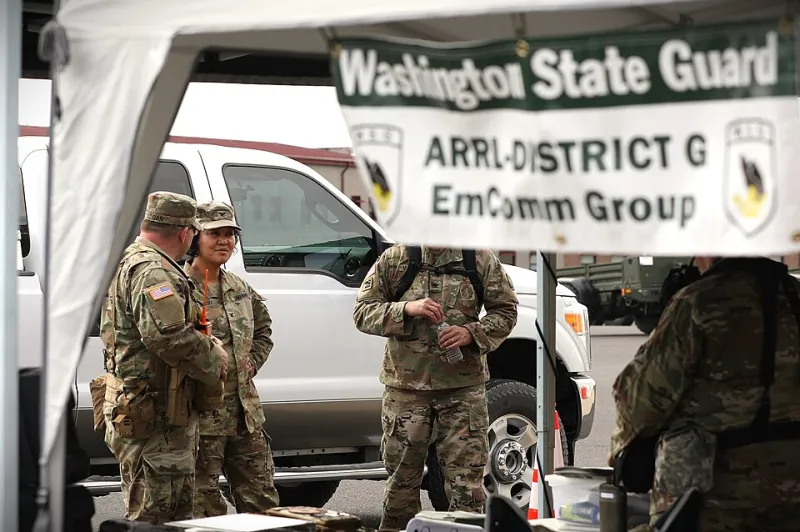
Photo: Spc. Abigail Clark, Public domain, via Wikimedia Commons
The Force Most Americans Have Never Heard Of
When a hurricane bears down on a coastal city or a catastrophic flood isolates an entire county, the public instinctively looks to the National Guard. That expectation is reasonable—but it rests on an assumption that does not always hold. In an era of sustained overseas deployments and simultaneous domestic emergencies, the National Guard is not always available. What fills that gap is a question most policymakers have been reluctant to answer seriously.
The answer, in many states, already exists—though it operates in near-total obscurity. State Defense Forces, sometimes called State Guards or State Militias, are military units authorized under Title 32 of the United States Code. Unlike the National Guard, they cannot be federalized. They answer exclusively to their state governors. They cannot be deployed abroad. And in theory, they represent precisely the kind of sovereign, locally accountable rapid-response capability that emergency management doctrine has long called for.
In practice, however, most of them are severely underfunded, poorly equipped, and largely invisible to the public they are meant to serve.
A Legal Framework Built for This Moment
The statutory basis for State Defense Forces is not a relic or an accident. Congress deliberately preserved the authority for states to maintain their own military organizations, separate from the federally accessible National Guard, precisely because of the lessons learned from earlier conflicts. When National Guard units were mobilized en masse during World War I and again during World War II, states were left with diminished capacity to respond to domestic emergencies. The legal architecture that emerged from those experiences was designed to ensure that governors would never again be left without a uniformed force under their direct command.
That architecture remains intact today. Approximately 22 states currently maintain active State Defense Forces, with membership ranging from a few hundred volunteers to several thousand. States including Texas, New York, California, and Virginia maintain some of the more developed programs, with dedicated training pipelines, logistics capabilities, and defined roles within their broader emergency management frameworks.
But the variation between states is striking—and troubling. Some programs operate with professional-grade standards and meaningful integration into state emergency operations plans. Others exist largely on paper, sustained by a handful of volunteers with outdated equipment and no clear mission assignment. The disparity reflects not a difference in need, but a difference in political will and budgetary priority.
What These Forces Actually Do
The operational record of State Defense Forces, where they have been properly resourced, is more substantial than their public profile suggests. During Hurricane Katrina, the Texas State Guard provided critical support to relief operations as National Guard units from multiple states were simultaneously managing overseas commitments. In the aftermath of Hurricane Harvey in 2017, the Texas State Guard again mobilized rapidly, conducting search-and-rescue operations, staffing shelters, and supporting logistics coordination at a scale that would have strained any single agency.
Beyond natural disasters, State Defense Forces have demonstrated value in continuity-of-government scenarios, cybersecurity support operations, and medical surge capacity during public health emergencies. Several states deployed their State Guard units during the COVID-19 pandemic to assist with logistics, vaccination site operations, and supply chain management—functions that required a disciplined, organized workforce but not the full military capabilities of the National Guard.
These are not marginal contributions. They represent exactly the kind of flexible, scalable, domestically focused capacity that emergency managers consistently identify as a gap in the national preparedness architecture.
Chronic Underfunding and Strategic Neglect
Despite this record, State Defense Forces remain chronically underfunded across most of the states that maintain them. In many cases, unit members are expected to purchase their own uniforms and equipment. Training budgets are minimal or nonexistent. Recruitment is conducted largely through word of mouth. There is no federal funding stream specifically dedicated to State Defense Forces, and state legislatures have generally treated these units as a low-priority line item—easy to cut when budgets tighten and difficult to justify to constituents who have never heard of them.
The absence of a strong advocacy infrastructure compounds the problem. The National Guard Association of the United States is a well-organized, well-funded lobbying presence in Washington. State Defense Forces have no equivalent. Their interests are rarely represented in federal preparedness policy discussions, and their potential contributions are consistently overlooked in national planning documents.
This neglect carries real costs. Every time a major disaster overwhelms local and state resources, after-action reports cite the same deficiencies: insufficient personnel, inadequate logistics capacity, poor coordination between civilian and military responders. State Defense Forces, properly resourced and integrated, could address each of these gaps—but only if they are treated as genuine strategic assets rather than ceremonial holdovers.
A Path Toward Revitalization
Reviving State Defense Forces as a meaningful component of national preparedness does not require a dramatic overhaul of existing law. The statutory framework is already in place. What is needed is a coordinated effort at both the state and federal levels to treat these units with the seriousness their mission warrants.
At the state level, governors and legislatures should conduct honest assessments of their State Defense Force programs—evaluating current capacity, identifying critical gaps, and committing to sustained funding that reflects the actual cost of maintaining a ready force. Integration with state emergency operations plans should be mandatory, not optional. Training standards should be formalized and enforced. Recruitment should be professionalized, with particular attention to individuals who bring specialized skills in medicine, engineering, communications, and cybersecurity.
At the federal level, Congress should explore mechanisms for supporting State Defense Force development without compromising their essential character as state-controlled entities. This might include grant programs administered through FEMA, technical assistance from the Department of Defense, or the establishment of minimum readiness standards that states must meet to qualify for certain categories of federal preparedness funding.
Perhaps most importantly, the emergency management community must begin treating State Defense Forces as legitimate partners rather than afterthoughts. That means including them in planning exercises, sharing intelligence and situational awareness, and building the interoperability frameworks that allow these units to integrate seamlessly with National Guard, law enforcement, and civilian emergency management agencies when a crisis demands it.
The Broader Preparedness Argument
The case for revitalizing State Defense Forces is ultimately a case for redundancy—for building depth into a national preparedness architecture that currently relies too heavily on a small number of high-demand, federally accessible assets. The National Guard is a formidable institution, but it cannot be everywhere at once. When it is deployed abroad, or when it is already committed to one disaster while another unfolds, the absence of a capable, governor-controlled backup force is not a theoretical problem. It is a gap that has been exposed repeatedly, and that will be exposed again.
America has, embedded in its own legal framework, a ready-made solution to this problem. The question is whether the political will exists to fund it, develop it, and deploy it with the intentionality the moment demands. The playbook has always been there. It is time to open it.