When Washington Can't Answer: How Local Leaders Are Governing Through the Unthinkable

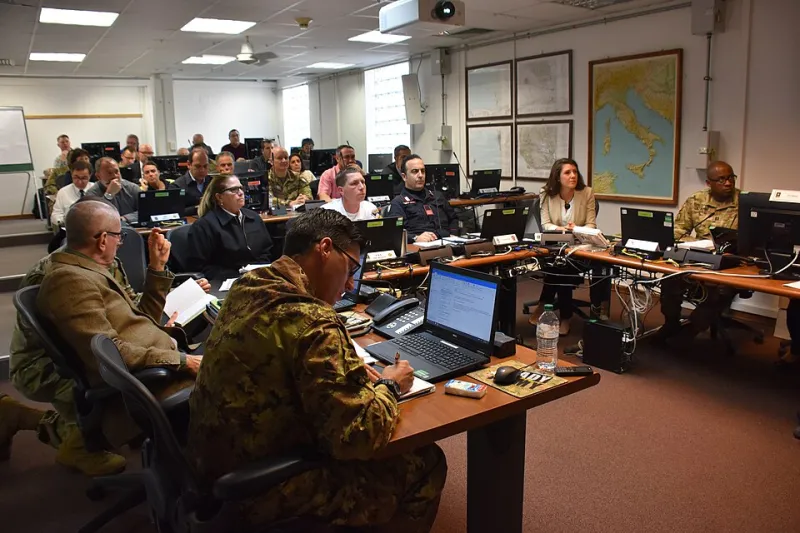
Photo: Ministry of Housing, Communities & Local Government, OGL 3, via Wikimedia Commons
In the days following Hurricane Katrina's landfall in August 2005, the city of New Orleans did not simply suffer a natural disaster. It experienced a governance collapse. The cascading failures — from levee infrastructure to federal coordination to local decision-making authority — revealed something that emergency management professionals had long understood but the public had not fully absorbed: in a severe enough crisis, the cavalry may not come quickly, and local leaders may have to govern alone.
Two decades later, that lesson has not been forgotten by the officials who carry the weight of public safety in America's counties, cities, and townships. Across the country, a deliberate and often underreported movement is underway — one in which local elected officials and their emergency management partners are constructing governance frameworks built not around the assumption of federal support, but around the possibility of its absence.
The Gap Between Assumption and Reality
Federal disaster response mechanisms — FEMA, the National Guard, the Strategic National Stockpile, the Stafford Act declaration process — are powerful tools. But they are tools with timelines. A presidential disaster declaration, even when granted quickly, typically takes days. Full federal resource deployment can take weeks. In the interval, local governments are on their own.
For most manageable emergencies, that interval is an inconvenience. For catastrophic events — a major seismic event along the New Madrid Fault, a coordinated cyberattack on critical infrastructure, a pandemic more severe than COVID-19, or a prolonged grid failure during extreme weather — that interval can determine whether communities survive intact or fracture under the pressure.
"We can't plan for the easy scenarios," said one county emergency management director in the Pacific Northwest, speaking on background because her contingency protocols are not yet public. "We have to plan for the scenario where we're making life-and-death decisions with no outside help for two weeks or more. That changes everything about how you think about governance."
Succession Planning Beyond the Basics
Government succession plans — the formal designation of who assumes authority when elected officials are incapacitated — exist in most jurisdictions as a matter of legal requirement. But many of these plans are thin documents, drafted to satisfy statutory obligations rather than to function as genuine operational guides.
A growing number of local governments are moving beyond these baseline requirements. In several Midwestern counties, commissioners have worked with legal counsel and emergency management teams to develop what practitioners call "deep succession" frameworks — tiered chains of authority that extend well beyond the standard deputy designations, with pre-authorized decision-making powers for specific emergency scenarios.
The city of Tulsa, Oklahoma, has been cited by emergency management professionals as an example of proactive governance continuity planning. Following a comprehensive risk assessment, city leadership developed scenario-specific protocols that pre-authorize department heads to take defined actions — from issuing emergency procurement orders to activating mutual aid agreements — without waiting for mayoral approval in situations where communication infrastructure may be compromised.
This kind of pre-authorization architecture matters enormously. In a genuine crisis, the minutes spent seeking approval up a chain of command that may not be reachable are minutes that cannot be recovered.
Decision-Making Under Uncertainty
Perhaps the most difficult aspect of crisis governance is not logistics — it is epistemology. How do leaders make consequential decisions when information is incomplete, communications are unreliable, and the normal feedback mechanisms of democratic governance have broken down?
Emergency management training programs increasingly address this challenge through structured decision-making frameworks adapted from military and aviation contexts. The core principle is consistent: in high-stakes, time-constrained environments, the goal is not to achieve certainty before acting. It is to act on the best available information while building in mechanisms for rapid reassessment.
Several state emergency management agencies have begun incorporating these frameworks into their training curricula for elected officials — a recognition that mayors and commissioners, not just professional emergency managers, will be making critical calls during major events. Virginia's Department of Emergency Management, for example, has developed tabletop exercise programs specifically designed for elected officials, simulating scenarios in which participants must govern through communications blackouts, infrastructure failures, and mass casualty events.
"Elected officials often haven't thought through what it actually means to govern when the phone doesn't work, when your staff can't reach you, when you don't know what's happening three blocks away," noted one state-level emergency management trainer. "The exercises are uncomfortable. They're supposed to be."
Building Civic Infrastructure That Endures
Beyond individual succession and decision-making protocols, the most resilient local governments are investing in what might be called civic infrastructure — the organizational, social, and physical systems that allow communities to function independently of external support.
This includes maintaining redundant communication systems: radio networks, satellite communication capabilities, and pre-established communication trees that function without internet or cellular infrastructure. It includes pre-positioning emergency supply caches at the local level, reducing dependence on state or federal delivery timelines. And it includes cultivating relationships with community anchor institutions — hospitals, faith communities, schools, civic organizations — that can serve as distribution points, shelter facilities, and coordination hubs during extended emergencies.
In Harris County, Texas — home to Houston and one of the most disaster-experienced jurisdictions in the nation — officials have invested significantly in neighborhood-level emergency coordination networks. These networks, staffed by trained volunteers and integrated into the county's formal emergency response structure, extend governmental reach into communities where formal infrastructure may be compromised. They represent a recognition that governance during a catastrophe is not solely the province of elected officials and professional responders.
The Democratic Dimension
There is an inherent tension in contingency governance planning that deserves acknowledgment. The mechanisms that allow local governments to act quickly and independently during crises — pre-authorized powers, streamlined decision chains, reduced procedural requirements — are the same mechanisms that, in other contexts, would raise legitimate democratic concerns.
The most thoughtful emergency management practitioners are acutely aware of this tension. The goal, they emphasize, is not to create parallel governance structures that circumvent democratic accountability. It is to ensure that the democratic institutions Americans have built can endure through catastrophe and emerge intact on the other side.
"We're not trying to replace democracy with efficiency," one county commissioner in the Mountain West explained. "We're trying to make sure democracy survives the emergency, so it's still there when the emergency is over."
That framing captures something essential about the work underway in local governments across the country. Preparedness is not the abandonment of civic values. It is their preservation — the deliberate, unglamorous labor of ensuring that the institutions communities depend on can withstand the worst that history might deliver.
The Readiness Imperative
The scenarios that local officials are planning for — prolonged grid failures, infrastructure cyberattacks, pandemic surges, major seismic events — are not remote possibilities. They are documented risks with historical precedents and credible probability assessments. The question is not whether such events will occur, but whether communities will be ready when they do.
For citizens, this work is worth knowing about — and worth supporting. Attend your city council meetings. Ask your county commissioners what their continuity of operations plan looks like. Inquire whether your local emergency management office offers community training programs. The resilience being built at City Hall and the county courthouse is only as strong as the civic engagement that surrounds it.
America's strength has always been rooted in the capacity of its communities to endure. That capacity does not emerge spontaneously in a crisis. It is built, deliberately and in advance, by leaders and citizens who refuse to assume that someone else will handle the hard work of preparation.